Spaso-Evfrosinevsky Monastery
Polotsk is one of the oldest cities in Kievan Rus. The history of this principality is closely connected with the name of Efrosinya of Polotsk, a princess canonized by the Orthodox Church. It was under her and through her efforts that the monastery was founded in 1125, today called Spaso-Efrosinievskiy. It is not surprising that today it is one of the holy places of White Rus' and the most ancient monastery here. Due to its location (the lands of the former Principality of Polotsk were the subject of territorial claims of the Moscow State, the Grand Duchy of Lithuania, and later the Commonwealth), the monastery several times passed to the Jesuits, then again became Orthodox. In 1820, when Polotsk was part of the Russian Empire, the Jesuits were expelled from its borders. One of the greatest shrines returned to the monastery - the Cross of Euphrosyne of Polotsk, created in the 12th century by the master jeweler Lazar Bogsha, with particles of the relics of saints and the Life-Giving Cross of the Lord.
The oldest temple of the monastery is the Cathedral of the Transfiguration of the Savior, built by St. Euphrosyne in 1161. The church is a unique example of a special architectural style, the style of the Principality of Polotsk. Interestingly, its walls have survived to this day almost intact from the 12th century! Inside there are marvelous frescoes of the same century.
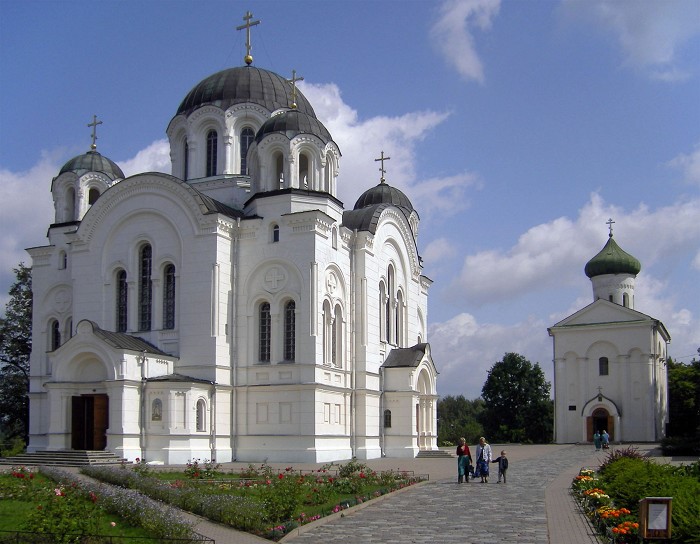
Other temples of the monastery are not so ancient, but no less beautiful. In particular, the Exaltation of the Cross Cathedral, built in 1897 in the pseudo-Byzantine style, designed by the architect Korshikov, or the warm Efrosinevsky Church. The main shrine of the monastery is the relics of St. Euphrosyne, as well as the restored Cross - its original, created in the 12th century, disappeared in 1941 and has not yet been found.
The local bell tower is also noteworthy, for which in 2001 three new bells were cast in Minsk, and in 2002 a festive evangelist weighing more than 3 tons joined them. In addition, there are sister buildings on the territory of the monastery, where more than 70 nuns live today.